
Can we take fear by the throat and look it straight in the eye? Will it shrink? Will it disappear?
The author's diary entries offer a glimpse inward, into the intimate realm of the soul. A calling out, a questioning, a groping in the dark, all the while knowing that the light switch must surely be there – I have found it once before and turned on the light, so why do I keep switching it off again and again?
From an interview by Adéla Brabcová with the author:
What are Flowers of the Night about, and what themes do you explore in the production?
They are about the fact that even in the night, in darkness, anxiety and loneliness, something can blossom. About how sometimes we have to fall apart in order to find ourselves among the ruins. About the hope that I can be given a new heart, that I have the chance to begin again – all I have to do is say: I want to. The central theme is the dark night of the soul – in other words, the loss of support, joy and hope – and a record of moving through this darkness, of searching for a way out.
You explore deeply intimate themes in the production. How important are they to you personally?
These are states of being and situations I have lived through. I say lived through, but I don't mean that they have been resolved once and for all. On the contrary, the entire script unfolds in a circle: doubts, uncertainties and anxieties return, changing in form and intensity, and none of them ever disappears for good. The text suggests that these things cannot be “solved”, that pain is an integral part of life and a teacher in its own right. And just as these painful things keep returning, so too do hope and a deeply buried will to find meaning.
What prompted you to transform your own life experiences into a theatrical work?
For quite some time, I have been working with my diary entries by weaving fragments of them into my scripts. This time, I decided not to use another character as a mouthpiece for these texts, but instead to openly acknowledge them, and the states of being they describe, as my own. Naturally, after writing the first draft, I asked myself whether it had the potential to speak to others, and I let several people read it. They confirmed that it touched them deeply on a personal level. And so I decided to take the risk.
What characters will audiences encounter on stage, and what role do they play in the story?
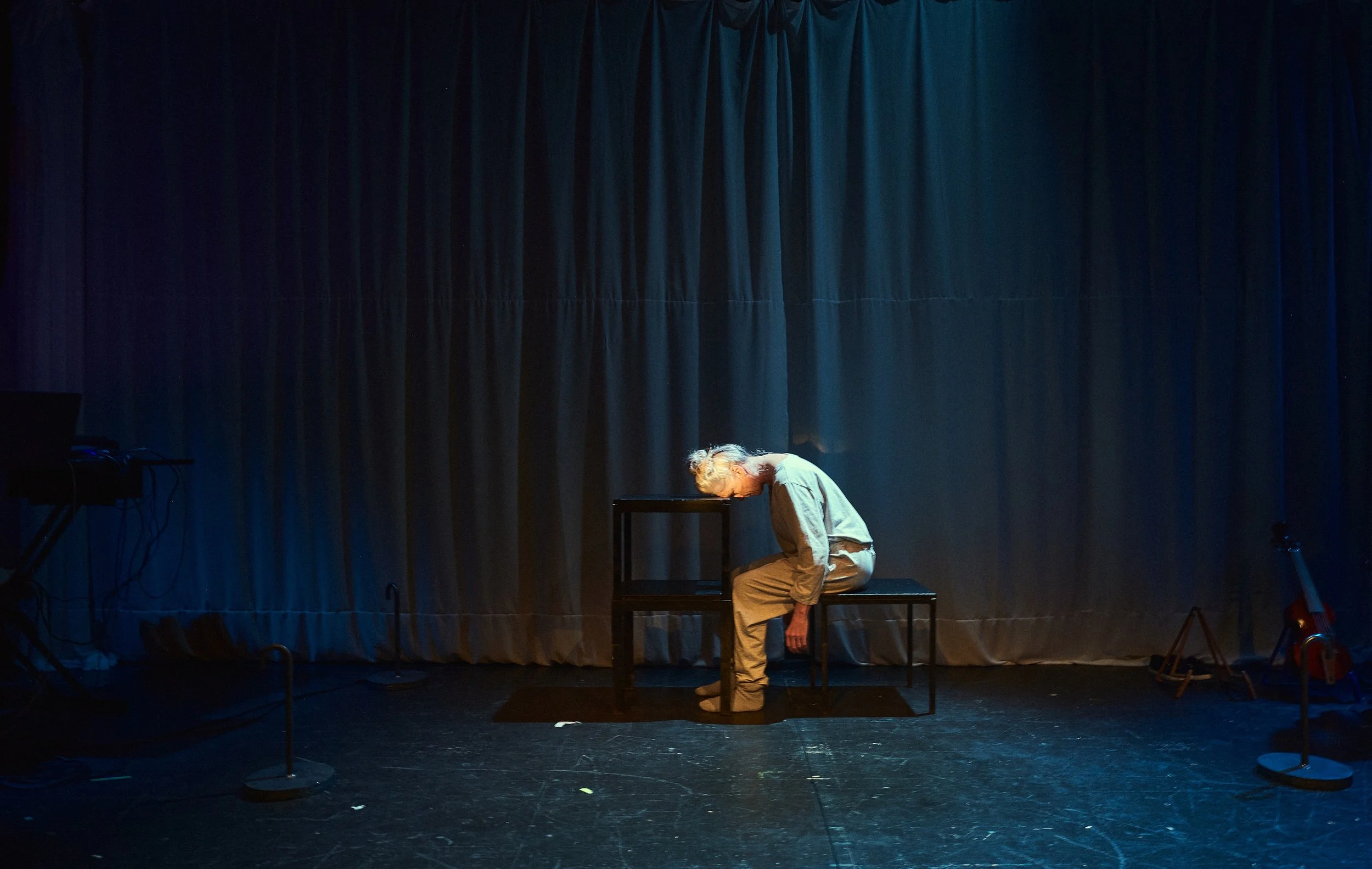
The audience will see and hear two women and two men. All four performers – an actress, a singer, a musician and a visual artist – represent different voices of a single person who finds herself at a point of crisis at the beginning of the performance. Together, all four embark on attempts to emerge from this dark night; to borrow from the title, they are trying to find something that might blossom.
Mélusine de Pas sings and also plays the viola da gamba. When I am drowning, her voice pulls me above the surface so that I can breathe again. Sometimes this develops into a dialogue.
Michal Rataj creates the musical and sonic world on stage – both the external and the internal one. We find ourselves in an apartment, a monastery, on the street and in a garden.
In the first part of the performance, Petr Nikl accompanies me with his micromagic; in the second, he makes use of the entire theatrical space.

LUCIE TRMÍKOVÁ
FLOWERS OF THE NIGHT
Can we grab our fear by the throat and look it straight in the eye? Will it grow smaller? Will it disappear?
Running time: 1 hour 10 minutes, no interval | Premiere: 13.4.2025
CREATIVE TEAM:
WRITTEN BY: Lucie Trmíková
DIRECTOR: Jan Nebeský
MUSIC & SOUND DESIGN: Michal Rataj
SINGING & VIOLA DA GAMBA: Mélusine de Pas
VISUAL PERFORMANCE: Petr Nikl
PRODUCTION MANAGER: Jakub Brunclík
CAST: Lucie Trmíková, Petr Nikl, Michal Rataj, Mélusine de Pas
NEXT PERFORMANCE



“The French theatre reformer, the accursed Antonin Artaud, writes:
“In the theatre – in the true sense of the word – the spectator recognises their own true nature, an experience that brings about an extraordinary and lasting strengthening of the self, while at the same time revealing the true nature of the world. One looks both outward and inward, witnessing the age-old struggle between the forces of good and evil. More than that, one comes to understand the meaning of evil…”
Only in the greatest works of theatre – for example, in the Living Theatre’s Antigone, or in the performances of Jerzy Grotowski (…) – can something of this kind be recognised and truly felt. And now, too, in Lucie Trmíková’s performance Flowers of the Night. (…)
I know of no other confession in the contemporary Czech cultural landscape – not just in theatre – that is so harrowing, so deeply etched into the very soul of its creator. A confession full of doubt and uncertainty, yet one that gives us the strength to live. (…)
Other artists on stage are also essential to Trmíková’s deeply personal expression. Michal Rataj’s musical passages could stand entirely on their own. At times, it is as if we were watching one of his concerts. The violist and singer, the French-born Mélusine de Pas, offers moments of understanding and occasionally provides a musical commentary on the unfolding situations.
But her principal partner on stage is the visual artist and performer Petr Nikl. Anyone familiar with Nikl’s work will sense the profound personal commitment that informs everything he does. Throughout his artistic life, he has repeatedly returned to his childhood in his work, maintaining a dialogue with his mother, a distinguished designer of rubber and inflatable toys, who, like Trmíková’s father, died prematurely.
Although I do not share many of Trmíková’s views on spirituality and on God, both within us and above us, I hold this work in the highest regard. I recommend it to anyone seeking spiritual art. I know of no other work in our theatrical landscape that is more deeply informed by its cultural and intellectual context, more intricately crafted in its use of text, or more profound and authentic in the commitment of everyone involved, both on and off stage. (…)
And indeed, take a look at the cover photograph of the printed programme. It shows Trmíková in a provocative pose, her eyes raised towards us, the spectators looking down upon her. Her body and expression convey both surrender and eroticism, but also severity, fear and a multitude of questions. It is as if she were asking: Will you understand me? Will you accept me and my openness, my honesty? Or will you reject me?
Oh, God… Oh, spectator…
Foto: Bet Orten